In our fast-paced competitive business and public service environments, small and medium-sized businesses (SMBs) and small and medium-sized enterprises — including school districts, universities, life sciences organizations, public services organizations, state and local government organizations (SMOs) — must uniquely leverage their human capital effectively to become and to remain competitive. Our Innovation Talent Advantage™ is a unique talent growth mindset to harness employee potential, to drive innovation, and to achieve ROI-driven, long-game competitive growth.
Innovation Talent Advantage™ is built upon a proven premise — Innovation attracts Talent.
Traditional talent management focuses on recruitment and retention. Yet, true top-quintile growth and innovation outcomes demand that SMBs integrate talent development with their core business strategies. Best innovation cultures foster continuous learning, Agile adaptability, and proactive leadership growth. Innovation Talent Advantage™ represents 100+ years of curated talent research, ROI-driven investment banking expertise and talent-centric innovation leadership — all distilled into an affordable innovation roadmap.
Innovation Talent Advantage™ is a singular proven framework for building Innovation — Gallup research guided by pragmatic DISC insights that drive Talent Economics success.
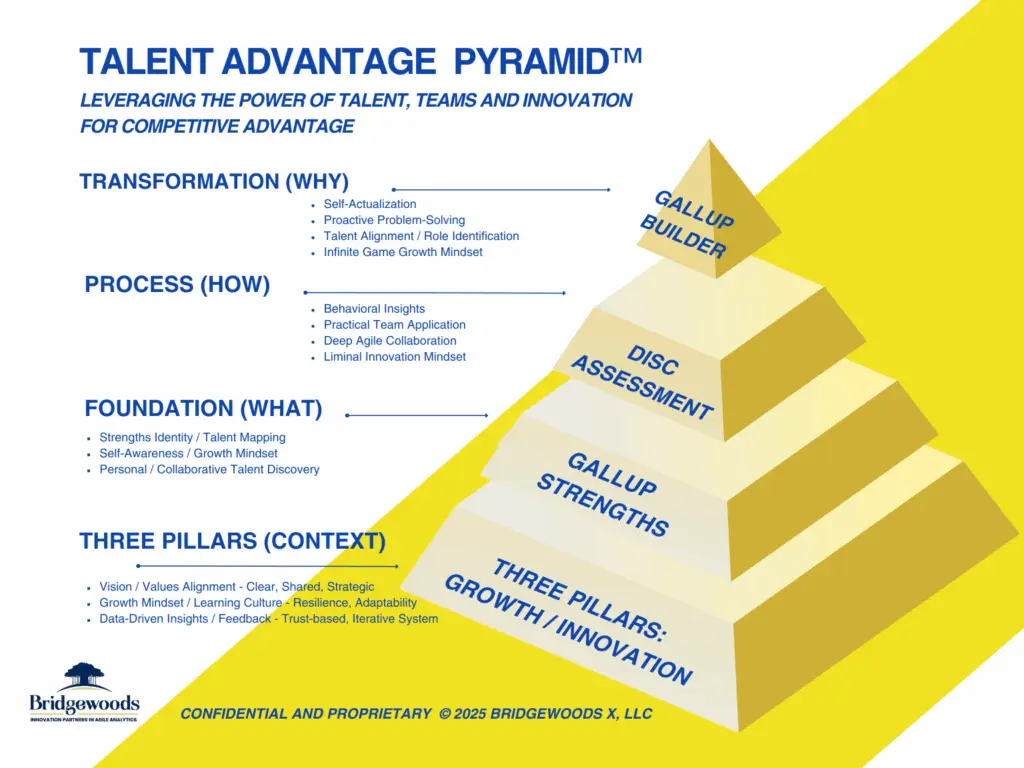
At the heart of the Innovation Talent Advantage™ and its proven Talent Economics success lies Talent Advantage™ Pyramid, a model designed to cultivate and harness the full potential of an organization’s workforce. This talent growth pyramid has four ascending tiers:
Talent Advantage™ Pyramid: This Gallup research-based and experiential-proven talent growth model outlines the progression of holistic talent development within an organization:
A. Three Contextual Pillars (Base): Establishing core elements such as Vision & Value Alignment, a Growth Mindset & Learning Culture, and Data-Driven Feedback Systems. These pillars ensure clarity, cohesion, and a commitment to continuous improvement.
B. Foundation (the WHAT of Talent Development): Bringing Clarity to the essential building blocks of self-knowledge and identified strengths that enable deep personal development and team contribution.
C. Self-Knowledge and Application (the Process for HOW to Grow Talent): Utilizing tools like the Gallup Strengths Finder and DISC Assessment to identify individual strengths and behavioral styles. This self-awareness facilitates effective collaboration and practical application within teams.
D. Transformational Leadership (the Apex for WHY Grow Talent): Implementing initiatives such as the Gallup Builder Initiative to cultivate proactive, innovative leadership. This top tier focuses on strategic problem-solving and fostering an environment conducive to continuous growth, innovation and self-actualization.
Talent Advantage Economics: High-fidelity talent development transforms status quo talent into enduring competitive market advantages. Highly-engaged talent environments fuel superior competitive advantage economics via enhanced innovation, robust corporate growth culture, improved customer relationships, and far more collaborative and informed business decisions. Talent advantaged organizations gain a significant long-game competitive advantage — over their Status Quo oriented peers — via their rational investment in long-game engaged talent economics.
Competitive Talent Advantage drives high-performance, long-game Economics.
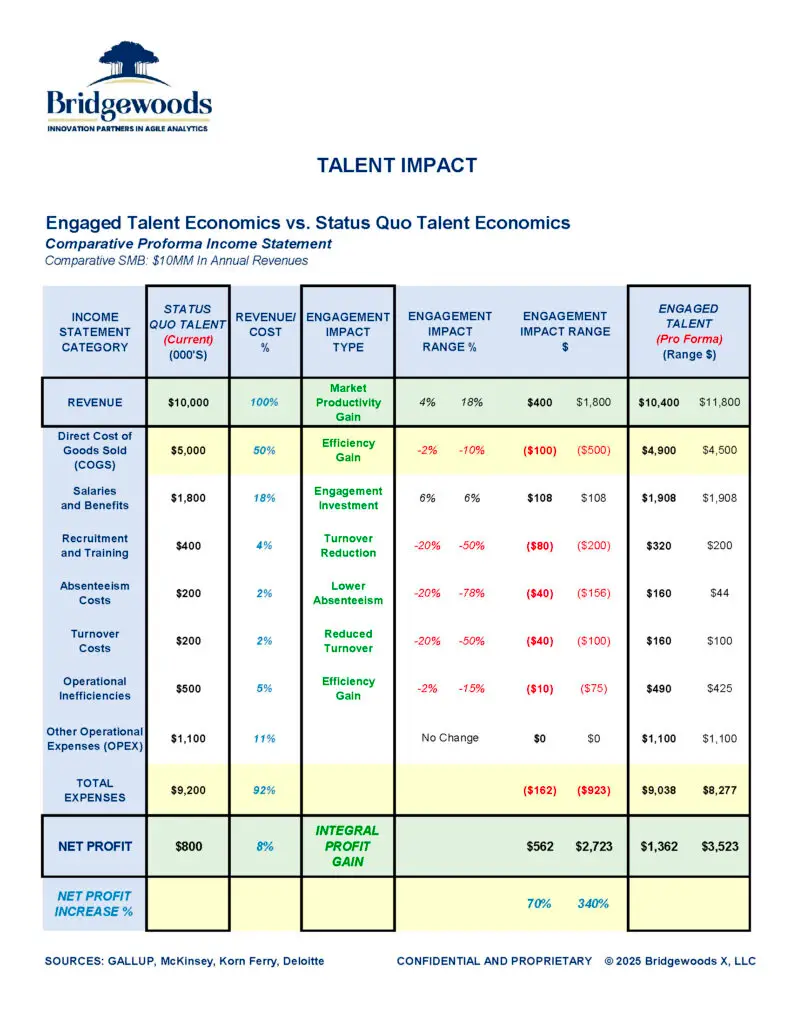
Talent Economics — as the tangible, proven economic impact of strategic talent management on organizational performance — reflects the talent science of investing in talent development.
“The only sustainable Competitive Advantage is an organization’s ability [talent] to learn faster than the competition ….”
— Peter Senge, The Fifth Discipline
Innovation Talent Advantage™ — and its associated Talent Economics — drives Market Productivity, Production Efficiency Gains, Talent Engagement, Turnover Reduction and Lower Absenteeism for an overall expected SMB / SMO Profitability and Efficiency Gain in the 5% to 25%+ range.
Innovation Talent Advantage™ drives typical proven, researched SMB Profitability Gains set out in the Engaged Talent Economics comparative income statement above. The proven researched outcomes enable SMBs and SMEs to typically achieve the four types of deep Competitive Advantage for top-quintile organizational economics as follows:
For SMB and SMO leaders, the Innovation Talent Advantage™ is not merely a theoretical model but a uniquely practical roadmap to achieving sustained success. By integrating the principles of the Talent Advantage™ Pyramid and understanding the economics of talent — organizations can:
To implement the Innovation Talent Advantage™, SMBs and SMOs should:
People-centric talent strategies demand investment in holistic talent platforms. Innovation Talent Advantage™ uniquely provides an affordable talent platform for SMBs seeking long-game Competitive Advantage. SMBs — via Innovation Talent Advantage™ — can more readily transform their workforce into a dynamic asset, driving innovation and securing their sustainable competitive edge in today’s dynamic marketplace.